
Break Out!

“Can Tricia Write a Mystery?” is a file stored in my computer. I also have “Can Tricia Write a Mystery 2” and “Can Tricia Write a Mystery 3”
I’ll end the suspense right here. No, she cannot.
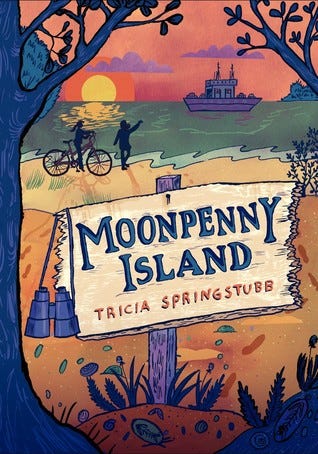
She—I—tried. It was going to be my third middle grade novel, coming after What Happened on Fox Street and Mo Wren Lost and Found, and I really wanted to mix things up! I had the perfect setting—a small island in a great lake, during the winter when the summer folk were gone and only a few hardy islanders remained. I had a (vague) idea that the discovery and theft of valuable fossils would cause mayhem and that my main character would be the son of the island’s lone police officer, who might be more on the side of greed than the law.
It still sounds so good! The only problem was: my process is to write my way into a story, working out the plot and themes as I go along. And then to revise (and revise), discovering the clues I left myself while I still didn’t quite know what I was doing.
Dang! This did not work with a whodunit style mystery, where it’s best to deliberately seed those clues and to know the outcome all along. At least, I think that’s how you write a real mystery, though I’ll never know, because after multiple (multiple! I really tried!) revisions I gave up. The book I eventually wrote was still set on that limestone, fossil-rich island, and still had a main character with a policeman dad, but it turned out to be a mystery of the heart (which, by the way, can be stolen as surely as any other treasure).
A few books later, I tried again to break out and write a genre I love—the historical novel. I loved researching Belgian women’s resistance during World War 2 , their heroic spying and their clandestine sabotaging of the Nazis, but I had massive trouble sticking to the form. When I sent a draft to my editor, she wanted to know details about where and when and why this war? I’d fictionalized so much, taken so many liberties with the facts, that any real history was erased.
It’s a long story, but that book eventually became contemporary fiction, too.
They say it’s good to know your strengths. I’ve definitely come to know my weaknesses. BUT! I still haven’t given up on writing outside my lane. And it’s possible that I may have at last succeeded. That’s news I can’t share yet, but here is a tiny hint: it feels like magic!

What joy that those attempts morphed into other real book projects! Fwiw, I believe in your ability to scale the Mystery Novel Mountain.
Don't give up hope!